

News | 29 October 2026
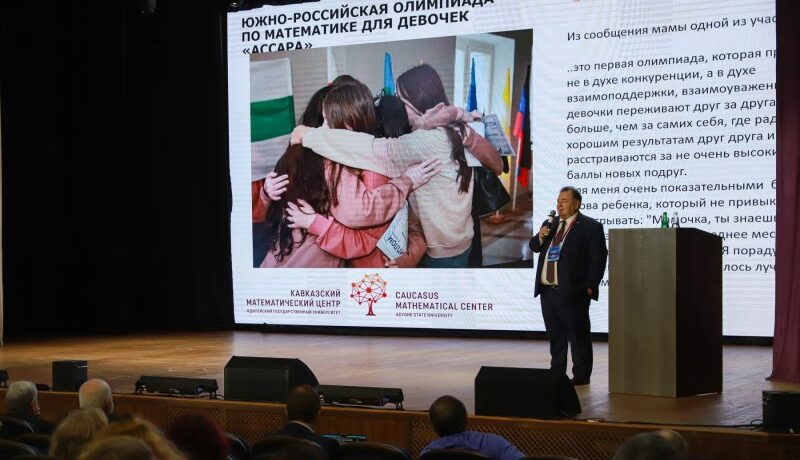
The 6th All-Russian Conference on “Mathematical Talent and Mathematical Education” opened at Adyghe State University on 27 of October. This year’s program focuses on one of the key challenges in modern education: how to develop mathematical abilities in a world where algorithms are increasingly being used to solve intellectual problems.
“We hold this conference every two years, and it has become a tradition. Each time, we discuss pressing issues in mathematics education. This year, we decided to focus on artificial intelligence, as many people are concerned about the future of mathematics and education amid the widespread use of neural networks. This topic is also important to achieving our goal of technological sovereignty: developing breakthrough technologies requires training a new generation of specialists. We also look forward to hearing about participants’ recent experiences and discussing their perspectives, ideas, and approaches,” said Daud Mamiy, Rector of Adyghe State University.
The conference brought together more than 140 participants, including scientists, educators, advocates, and developers of educational solutions from across the country. The program featured more than 50 presentations by leading researchers and practitioners in mathematics education.
Among the speakers was Ivan Yashchenko, who represented the Moscow Center for Continuous Mathematical Education, the Higher School of Economics, and the Moscow Institute of Physics and Technology. He leads the federal team responsible for developing the Unified State Examination in Mathematics and founded the Talent and Success Foundation. His presentation explored the role of artificial intelligence in advanced mathematics education in public schools.
Alexey Semenov, Doctor of Physical and Mathematical Sciences, member of the Russian Academy of Sciences, and head of the Department of Mathematical Logic and Theory of Algorithms at the Faculty of Mechanics and Mathematics at Moscow State University, spoke about AI, mathematical talent, and human mathematics education.
Sergey Rukshin, affiliated with Herzen State Pedagogical University of Russia, the Presidential Physics and Mathematics Lyceum No. 239, and the City Mathematics Center for Gifted Children in St. Petersburg, presented on the mathematical community in the modern world.
Anton Gusev, deputy director of the Talent and Success Educational Foundation and director of Sirius University of Science and Technology, discussed the economics of talent.
Nikolay Andreev, Director of the Steklov Mathematical Institute of the Russian Academy of Sciences, presented a paper entitled “Mathematics and Mathematical Education in the Age of AI: Unanswered Questions.”
The program also featured presentations by Kirill Sukhov, head coach of the Russian team at the International Mathematical Olympiad; Hayk Sargsyan of the National Academy of Sciences of the Republic of Armenia; Anton Gusev of the Talent and Success Foundation; and Evgeny Vdovin of Tyumen State University. Representatives from the Moscow Institute of Physics and Technology, National Research Nuclear University MEPhI, Sirius, and the Higher School of Economics also took part, alongside educational platforms and schools from across Russia.
A dedicated day, October 29, will focus on artificial intelligence and digital technologies in mathematics education. Alongside the conference sessions, a roundtable will examine how schools and secondary vocational education institutions are using AI in education. Participants will include representatives of the Ministry of Education and Science of Adygea, Adygea State University, the Republican School of Natural Sciences and Mathematics, and partner IT companies.
Experts will discuss the use of AI in teaching, assessing mathematical skills, and developing individualized learning pathways. They will also consider specialized courses for school students and the risks of using AI in Olympiad preparation.
The practical program will bring together three areas:
The conference is organized by Adyghe State University, the Moscow Institute of Physics and Technology, the Caucasian Mathematical Center at Adyghe State University, and the Republican School of Natural Sciences and Mathematics in Adygea. It will continue through October 31.
The conference program is available here.

